Travv MCP: Connecting AI Tools to Veterinary Diagnostic Data

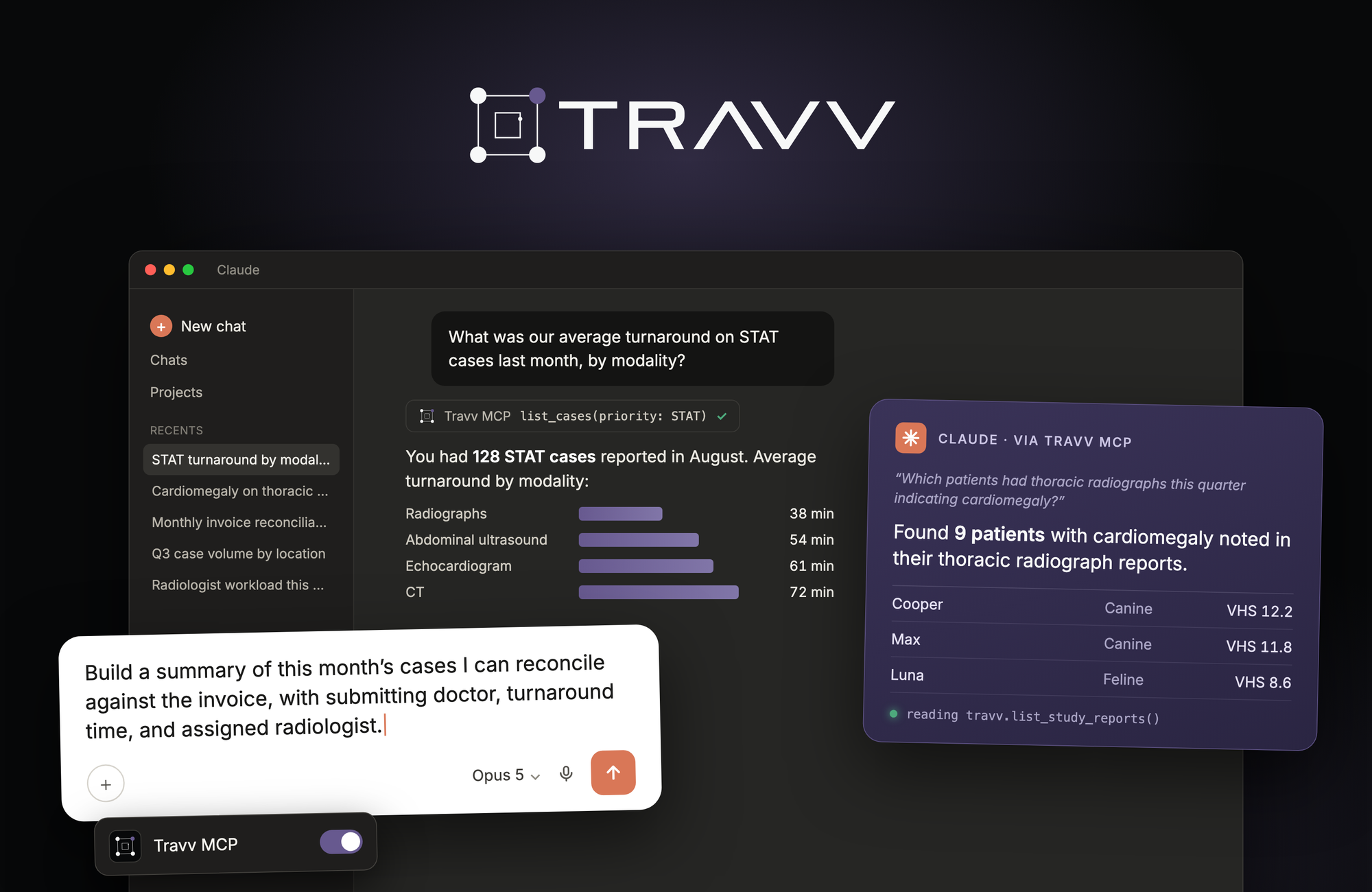
“Our turnaround times are worse today than they used to be!” I heard that complaint regularly from hospitals at a previous diagnostic company. When a client called, the first thing we did was pull the numbers, and the average was usually fine. The real problem was they had no visibility into their turnaround time, or really any of their diagnostic data at all, and needed us to do the analysis for them. And even that isn’t easy in large corporate labs using outdated legacy software that may take days to weeks (yes, weeks!) to complete searches.
Most veterinary diagnostics providers offer very little in the way of data analytics. If you want your hospital’s average turnaround time, or a breakdown of your caseload to find savings or areas of optimization, you’re largely on your own. Some platforms offer a fixed set of dashboards. Custom reports or deep analysis are rarely possible. And it’s never done quickly.
Travv’s MCP has changed that for our hospitals. A practice manager can ask Claude or ChatGPT, “What was our average turnaround time from Travv last quarter, by modality and radiologist, and put it into a PDF with trendline comparison to the last quarter?” and get an answer in minutes, without calling anyone. And then have it autogenerated every quarter and dropped into her email inbox. And get something like this:
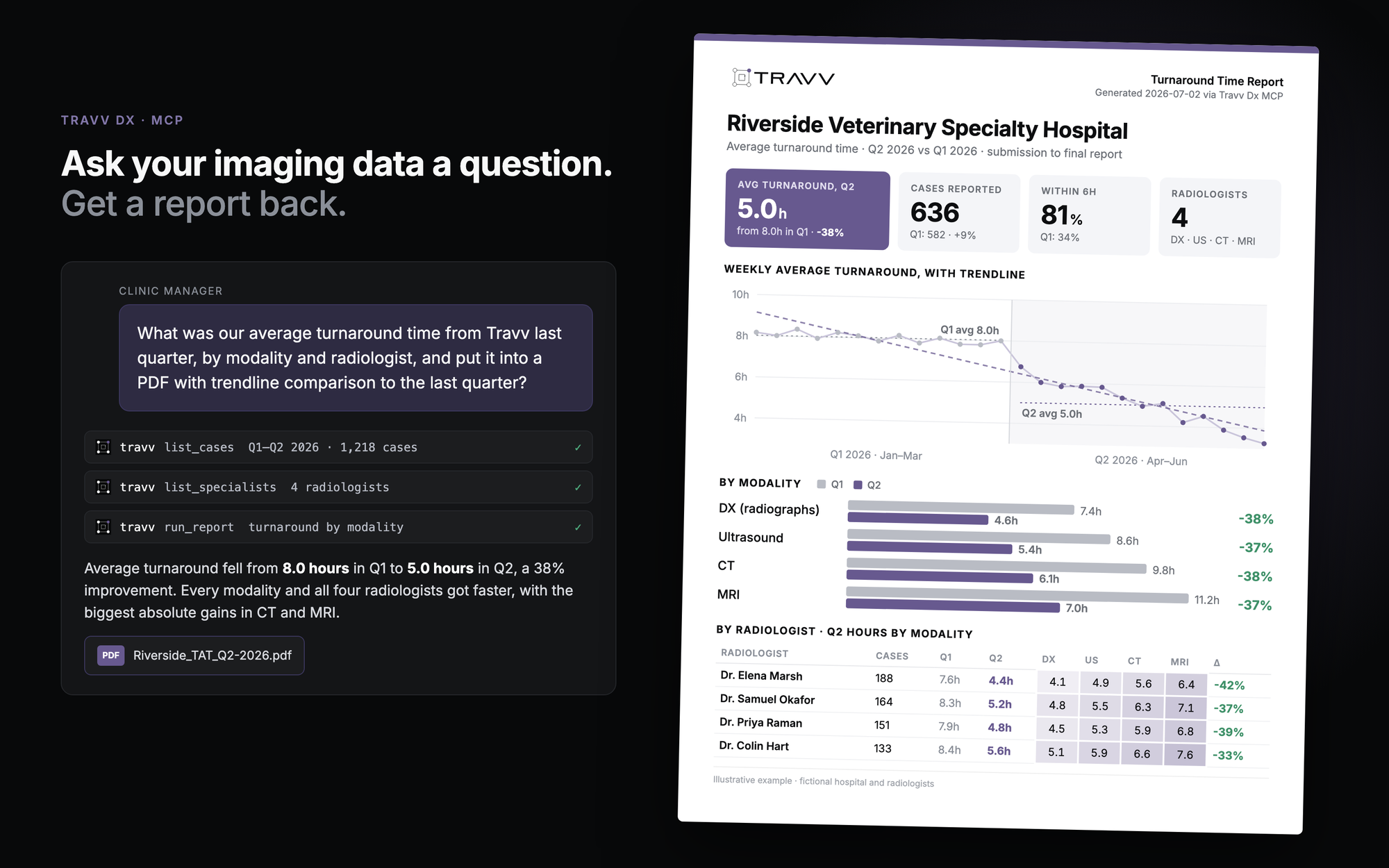
Here’s how Travv’s MCP works, and what it makes possible for hospitals, corporate groups, telemedicine teams, and equine sales organizations.
What is an MCP?
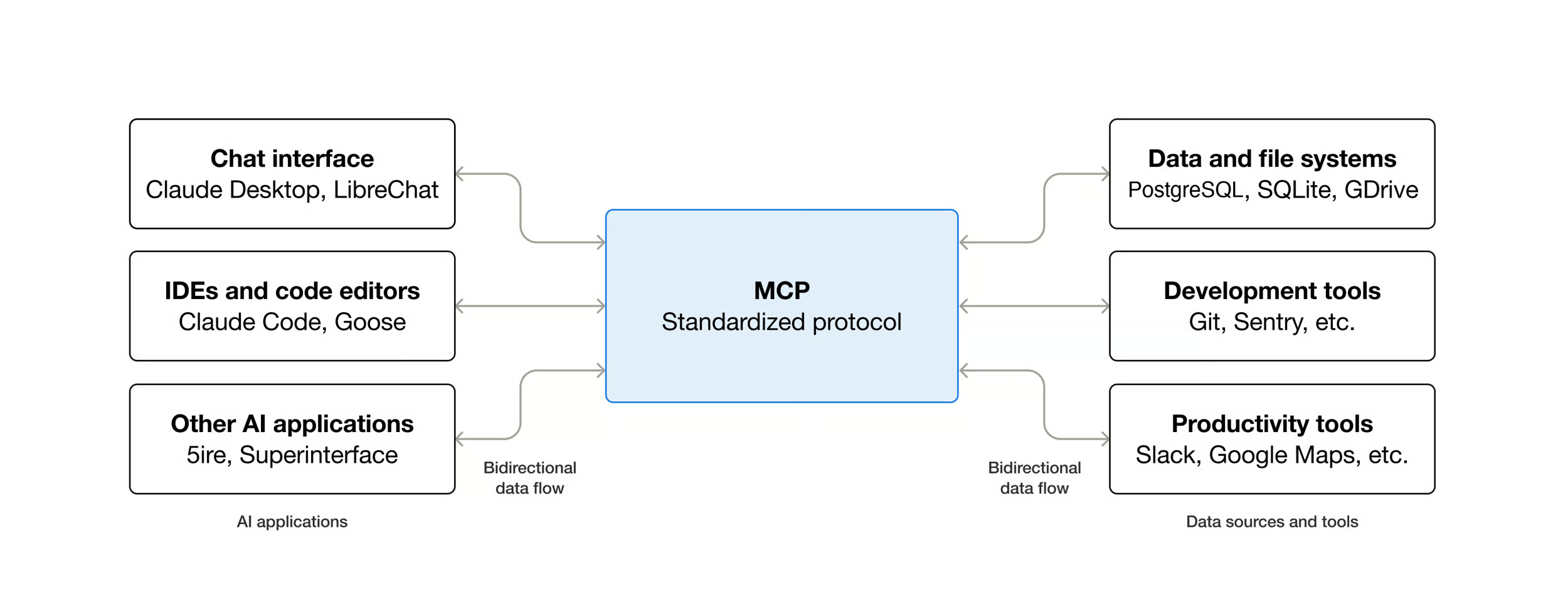
MCP stands for “Model Context Protocol”. It is an open standard that lets AI tools like Claude and ChatGPT connect to the software you use. It’s like a USB-C port on software that your AI tool can plug into. If you’ve ever worked with teams setting up an API between two pieces of software you know it takes weeks of working together to complete. But an MCP allows you to connect your Claude or ChatGPT to software in seconds with a mouse click.
But is it secure?
MCP is not unfettered access. Your AI only sees what your normal login allows you to see, based on permission settings. On top of that, the software company decides what the MCP can read, what it can change, and what stays off limits.
How is MCP being used across industries today?
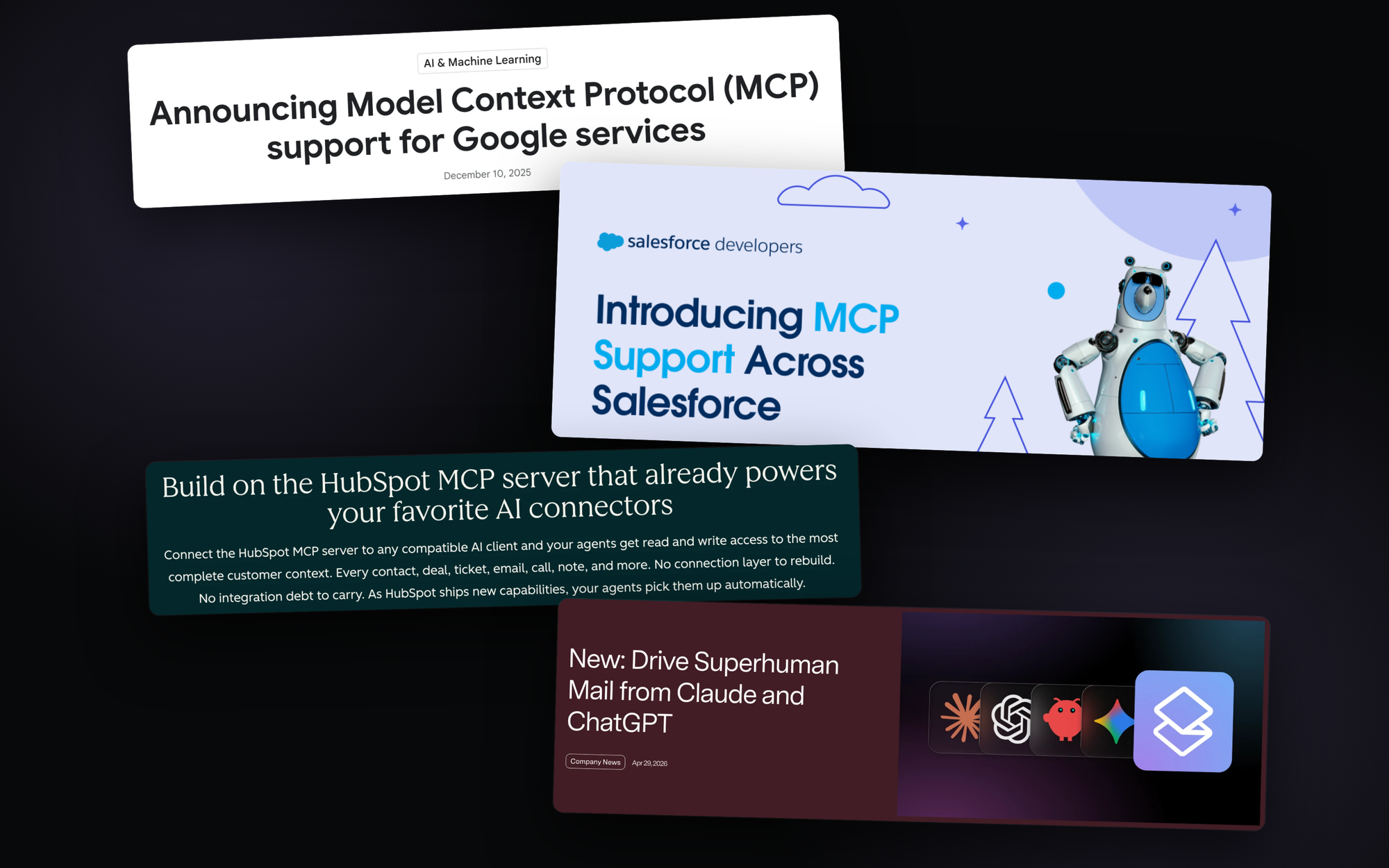
Over the past year, companies like Superhuman, HubSpot, Salesforce, QuickBooks, and many others have released MCP connectors that allow customers access from their AI platforms. Prior to that, companies were building their own AI features and trying to get customers to use them. Now they are letting customers bring the AI tool they already use and point it at their data. MCP allows your AI to pull from your email, CRM, books, and diagnostic data and will make you feel like you have superpowers.
What Travv’s MCP does
Travv’s MCP gives veterinarians, corporate hospital groups, partners, and telemedicine teams using the Travv Dx platform direct access to their data. You can run reports, summarize trends, package studies for download, and do the kind of deep analytics not possible in cookie-cutter dashboards. All of this happens with the AI tools already in use by the organization such as Claude or ChatGPT.
How do veterinary hospitals use Travv’s MCP?
A practice manager or medical director can now ask things like:
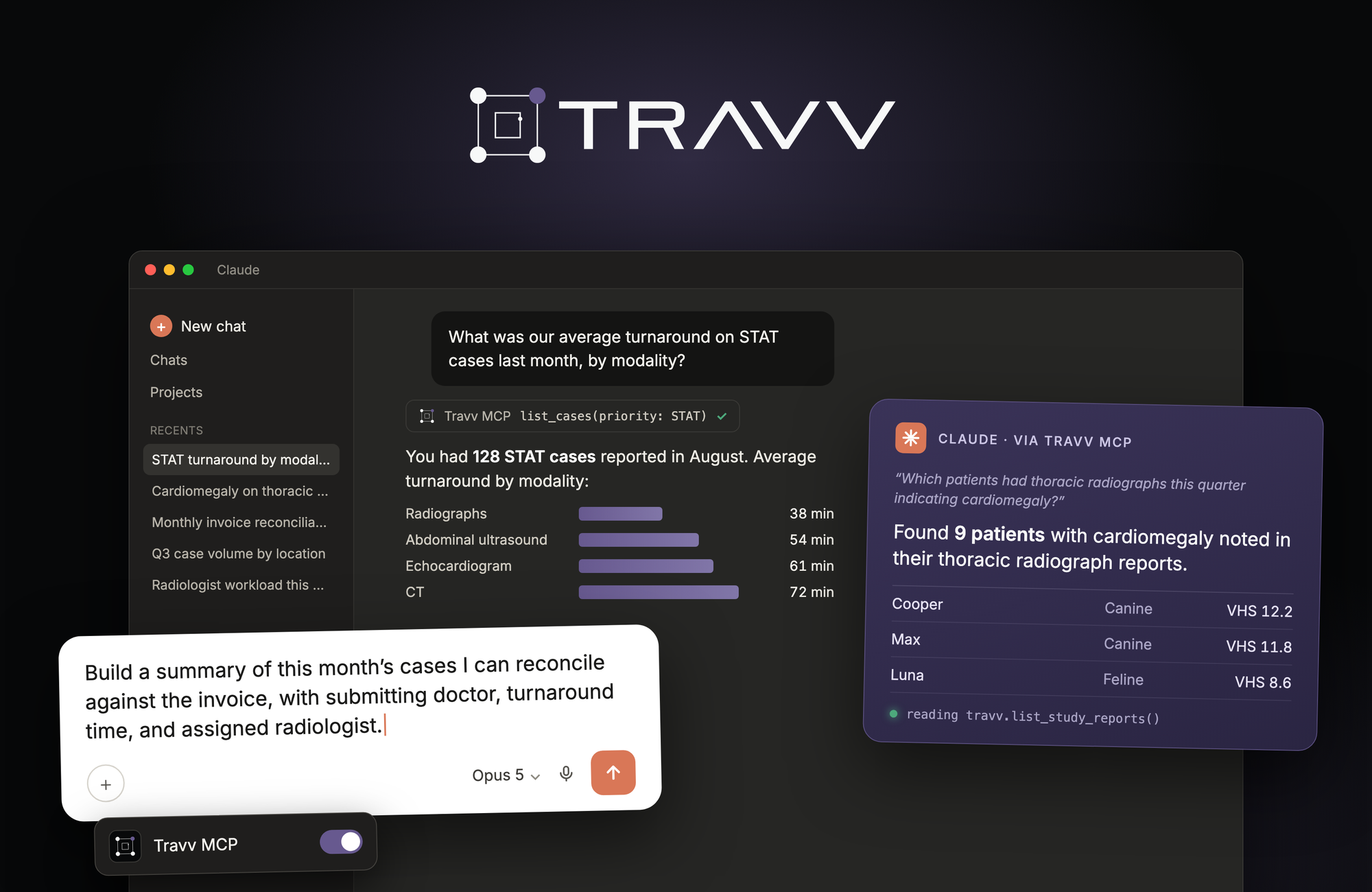
For corporate groups, the value compounds. Robust data analysis across all hospital sites is now unlocked. No hidden surprises.
A regional medical director overseeing 30 hospitals no longer needs an analyst to compare each site’s trends of radiology studies taken, total data stored, number of consults sent, turnaround time performance by site, etc. From single queries to scheduled analytics, creativity is the limit.
How do telemedicine companies use Travv’s MCP?
Telemedicine companies thrive when managers are in tune with their data. Understanding specialist schedules, case and hospital trends, and financial impacts of changes across the company are all vital to a successful operation. But the limit in doing any of this well is often the rigid or limited reporting opportunities accessible to the operations team.
With MCP access, managers can do robust comparison of their specialist team’s performance across any number of metrics such as turnaround time, time spent per case, number of second opinions, hospital requests, or even search reports for specific findings. They can evaluate trends of hospital submissions and identify issues before they become a problem or lead to a lost client.
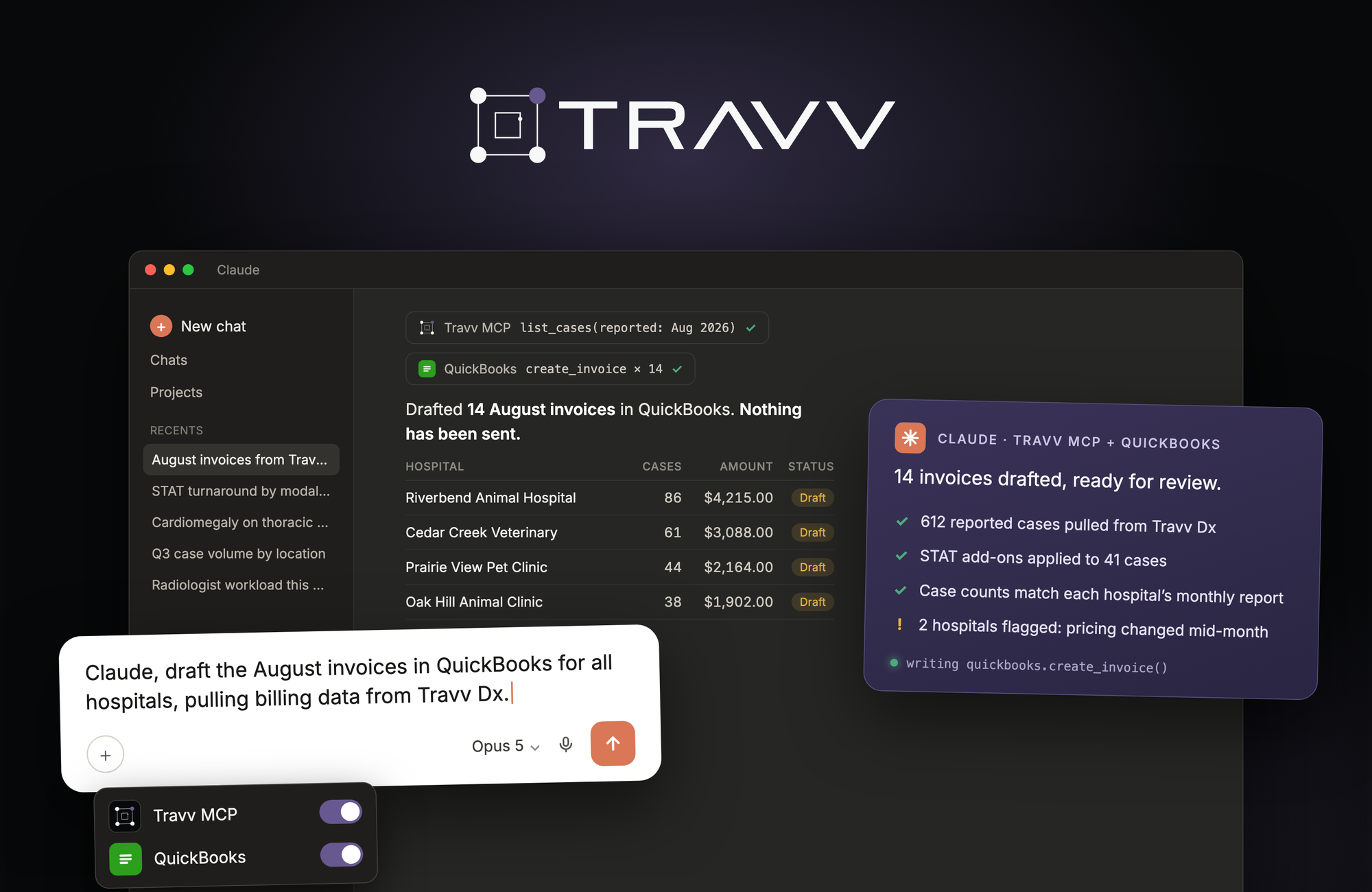
On the administrative side, the MCP can be used to automate invoicing, accounts payable, account creation and onboarding, and so many of the manual tasks that historically have required dedicated employees.
Here’s a powerful application for any team that wants to automate invoicing:
How do equine sales use Travv’s MCP?
A sale brings hundreds of horses, a set of standard views for each one, and buyers’ veterinarians who need specific images quickly. Travv already classifies radiographic views on every upload, with a number of AI models providing a suite of findings, measurements, and angles that give an additional layer of information about the horse. All of this is available to be queried via MCP as horses are compared. At the sales level, deep analytics across the entire cohort are possible, with opportunities to compare year over year.
Where this goes next
We are generating more data than ever in veterinary medicine, but we’re not integrating it. Think about a single patient with a lung mass. The radiographs live in one system, the cytology in another, the histopathology images in a third, and genomic data sits in its own database. But link them together across thousands of patients, and we begin to understand diseases in ways a single modality never can. We develop multimodal diagnostics and offer personalized therapy for the diseases that today have few options. That only happens if data is accessible between systems. MCP is one of the practical ways we knock down barriers to data access in veterinary medicine. We’re excited to offer Travv’s MCP to all veterinary hospital clients and partners. It’s free and one of the many benefits of working with Travv.
For decades, veterinary software has been stagnant with companies building walled gardens and giving hospitals little access to their own data. But the industry is changing. Everyone feels it. Travv intends to lead that change in veterinary diagnostics.
For more information, or to get a demonstration, reach out using the form below.